Researchers are builders. Humans are non-negotiable
Takeaways from Outliers 2026

The Golden Gate Bridge slowly emerging from the fog the day after the conference.
Last week I trekked down to San Francisco for Outliers, a conference hosted by Outset, which is an AI-moderated customer interview company. I went to connect with researchers and designers working where AI-native product development meets the future of UX research, and to learn from some of the best in the field.
I wasn't disappointed. What struck me most was how central human connection and judgment remained, even as the industry races to put AI into everything, everywhere, all at once. A second emerging theme is how UX Researchers can become builders to create AI-enabled work processes.
(In full transparency I obtained a free conference pass with a publicly available promo code on LinkedIn. I self-funded my accommodation, flights, non-conference meals/drinks, and ground transportation.)
The research execution layer is compressing, but human expertise is essential
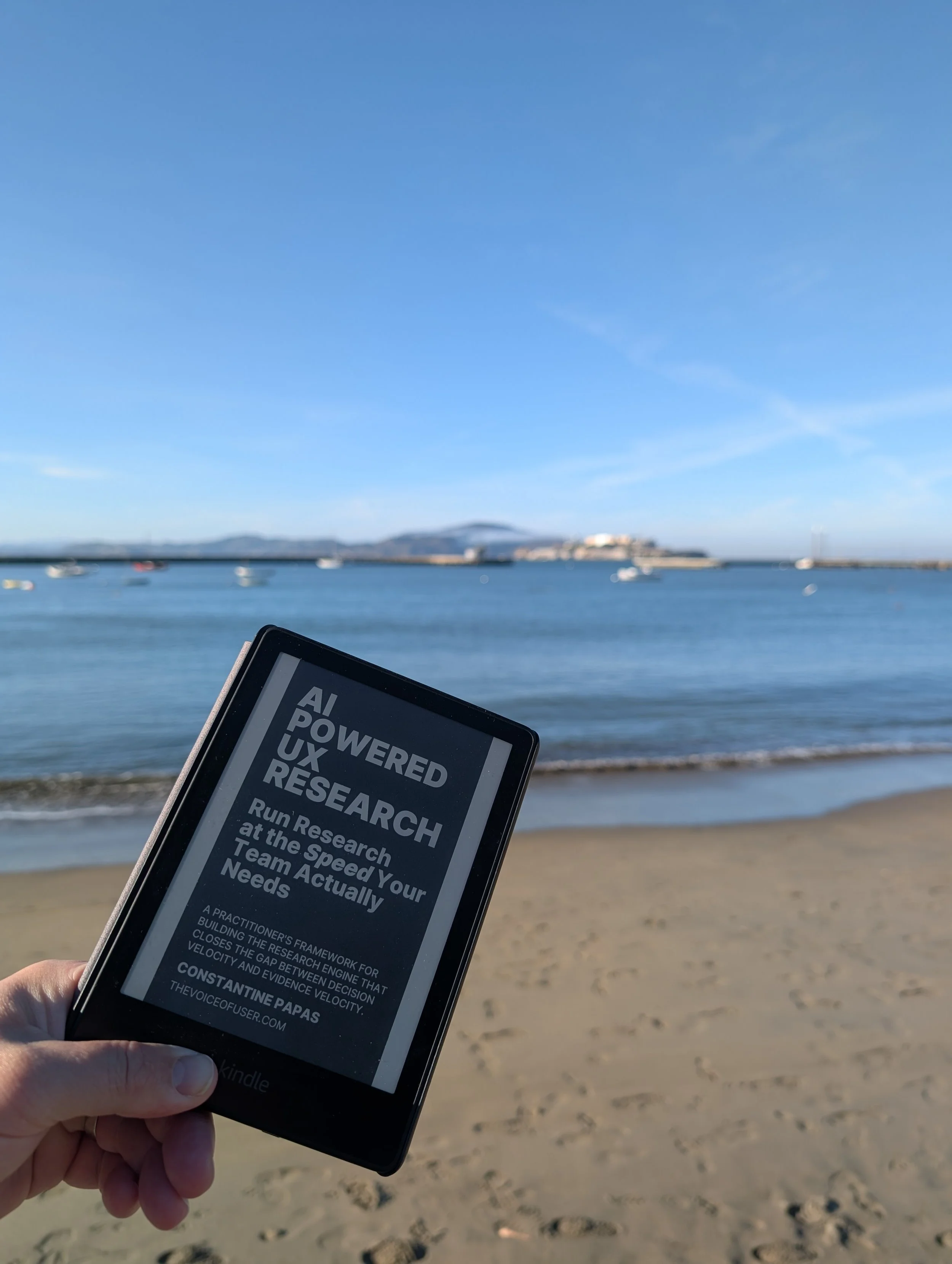
Some light reading with my Kindle about how to run UX Research at speed without sacrificing rigor or quality in the new AI era on the beach at Aquatic Park near Fort Mason the day before the conference.
Earlier this year my LinkedIn algorithm bubbled up some blog posts written by Constantine Papas, which are available on his website. After reading a couple posts I signed up for his weekly newsletter and found his hypotheses about where the UX Research discipline is heading to be provocative, yet pragmatic, with practical guidance on how to begin leaning into learning and experimenting with AI-enabled processes. This summer he wrote a book on AI Powered UX Research that expanded on his blog posts. I had put it on my reading list, and when I was graciously invited by Outset to attend his book signing brunch the morning of the conference prior to his presentation, it quickly became a priority. I’m not going to recap his work in great detail, and I encourage you to read his blog posts, and buy his book if you want to dig in deeper.
The concept that resonated with me the most in his book is that it'll be critical for the research discipline to close the gap between evidence and decision-making velocities. Engineering got an AI-powered turbocharger and we need to keep up. What he refers to as the frame is a practical framework teams and organizations can begin to implement to identify: what they confidently know about their users, what is known through research vs what are assumptions; how up-to-date the research insights are to ensure product decisions are being made with data that has not gone stale; and who is responsible for ensuring the elements within the frame are informing product decision-making as effectively as possible.
Constantine also outlines very practical guidance on how to keep the insights encapsulated by the frame in alignment with organizational strategic priorities by employing micro, sprint, and deep research methodologies. Micro research relies heavily on AI-moderated interview tools like Outset or Listen Labs, with human oversight, to answer tightly scoped, low-risk questions within 72 hours. Sprint research is best suited for moderately risky and ambiguous product decisions and is augmented with AI-moderated interviews. Deep research is predominantly human-moderated and AI-augmented for the most ambiguous and high-stakes workstreams that need durable insights.
I've studied human-AI interaction since 2016, and I think Constantine’s practical framework to triage research between micro, sprint, and deep engagements gives teams a clear way to match the method to the stakes of the decision. I’m excited to begin building processes in my work that leverage the frame methodologies.
Interacting with humans is not a problem to be solved
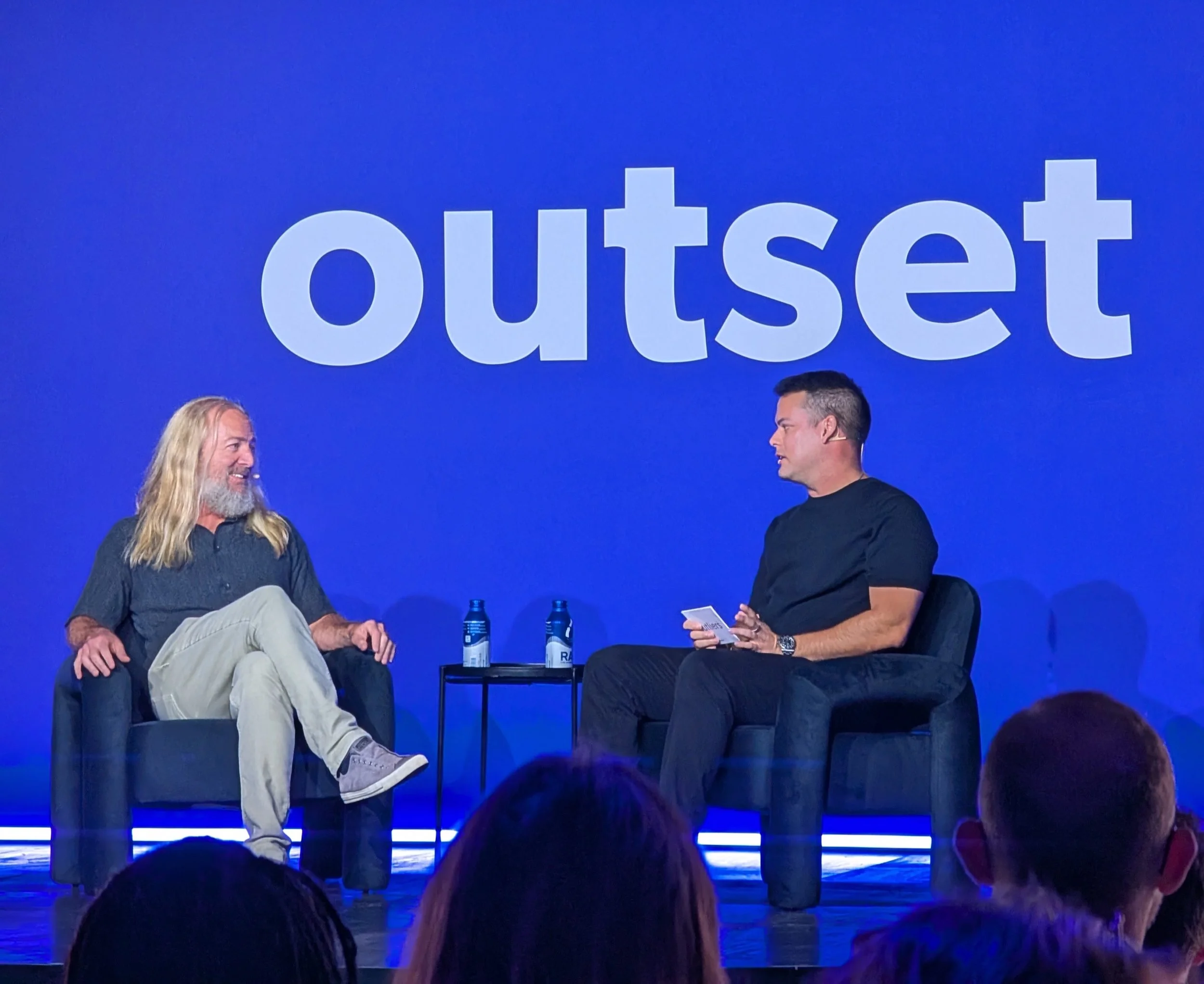
Mike Davidson, CVP of Microsoft AI, and Behzod Sirjani, Yet Another Studio founder, discussing the impact of AI on humanity and research.
The conference kicked off with a keynote discussion by Mike Davidson and Behzod Sirjani. Mike’s main focus was how the future of AI technology is still being defined, but is rooted in transformational shifts that have occurred throughout human history. The underlying theme for any new technological epoch is to “free you of the things you really don’t want to do, and enable you to do things you do want to do.” But what people don't want to do isn't always obvious. Mike mentioned that he was trying to sell his team on how AI can be used to quickly analyze open-ended survey questions at a scale never before possible, but there were those on his team who voiced they enjoyed doing that type of work. This highlighted that it is important for researchers, designers, and product builders to not be presumptuous about tasks which are not enjoyable for their target users. Later on Mike shared the sage wisdom that it is prudent to “design like you’re right, and test like you’re wrong” when building any new product or feature.
He also reassured the audience that it's ok to feel uneasy during this technological shift by saying “if you don't feel nervous, you're not paying attention.” It was comforting to feel seen in that moment, because things have been moving fast without a clear destination.
During the conversation he also touched on a couple of concepts that I had written about earlier, which is that AI has enabled anyone to become a builder, and that ensuring user experiences are building the right solutions for specific jobs-to-be-done is essential for success. As Mike put it, interacting with humans is not a problem to be solved. Users still ultimately expect a product, tool, or feature to intuitively work for them and make their lives easier.
My main takeaway from Mike’s talk was that research has the new capability to influence product strategy, lean into an experimentation framework, and keep users at the center of cross-functional strategy by acting as builders on the team. An example he gave was that research slide decks are less likely to be as important in the future, whereas researchers will have the ability to demonstrate the strategy and iterations for a product with rapidly produced prototypes rooted in user research.
How do you scale research while keeping the human touch?
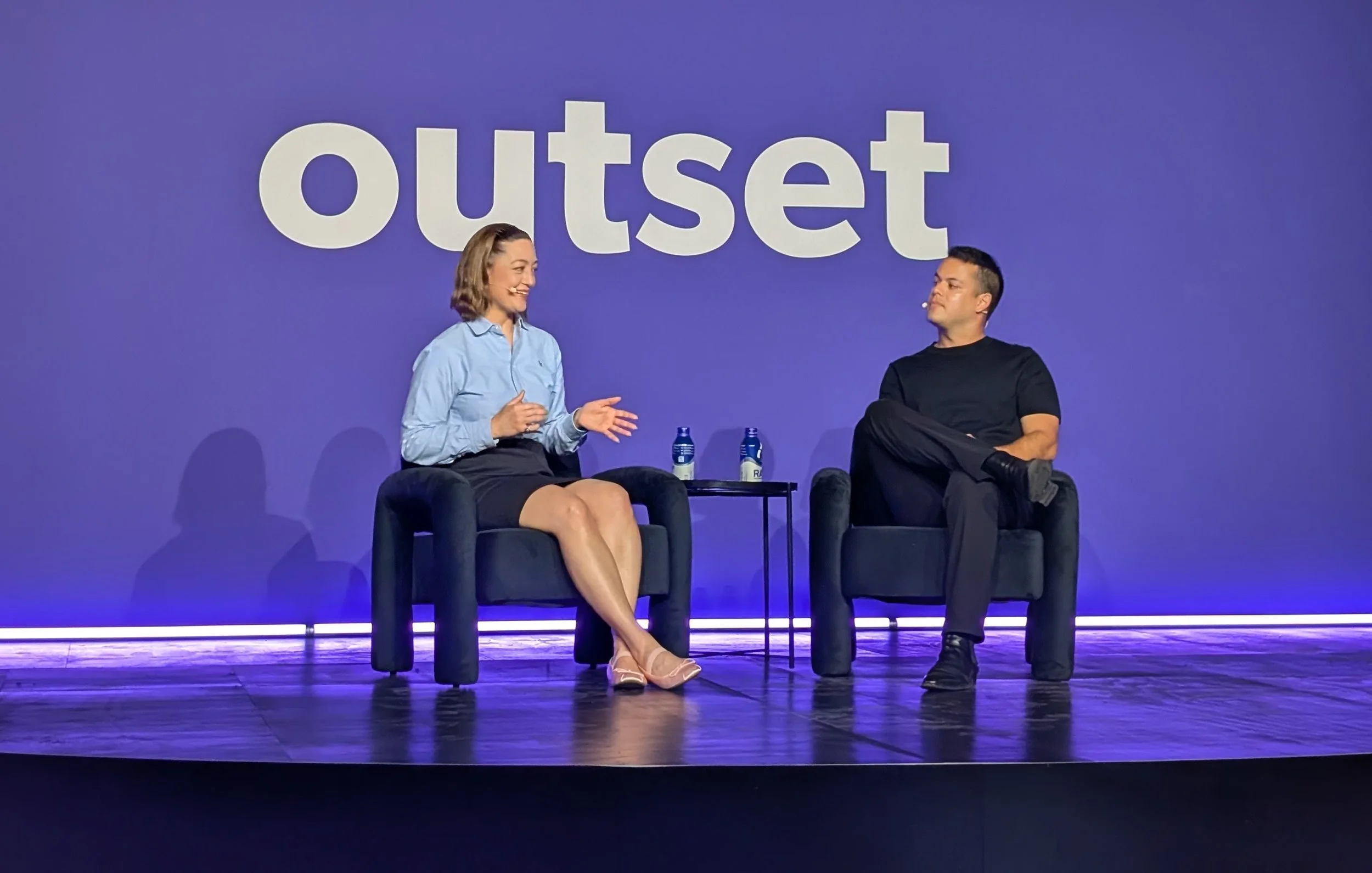
Jane Leibrock, Head of User Experience Research at Anthropic, and Behzod Sirjani.
The conference portion of the day ended with an afternoon keynote discussion with Jane Leibrock and Behzod Sirjani. Jane’s discussion on how an AI-native research team at a frontier firm operates very much resonated with the materials I had read in Constantine’s book. Ensuring the team works on what matters most to the business and influencing stakeholders effectively is critical for success. She accomplished this with a small but mighty team at Anthropic by building tools to automate and augment research processes, which allow her researchers to focus on the most critical human judgment components, while outsourcing or augmenting other tasks with AI. For example, when a study is initiated, an automated lit review is performed to identify what is already known and where there are still knowledge gaps, which helps researchers prioritize their limited time and resources for downstream steps. AI augments their recruitment and interviews, but researchers are still the final reviewers of the system’s outputs, test assumptions, explore underlying signals, and craft the final story for their stakeholders.
I loved that Jane highlighted how one researcher on her team made an effort to hand-curate the participant quotes that not only made her laugh, they made the entire cross-functional team laugh, which helped the insights land and maximize the impact of the study. It was a refreshing moment showing that processes at frontier firms still have a human element.
Jane also shared that everyone on her team is a builder, which was a cross-cutting theme across many of the breakout sessions. Microsoft AI researchers presented how they are building AI evaluation frameworks, and other research leaders emphasized that learning how to build AI-enablement tooling will be an essential component of a UX Researcher’s job duties in the future.
Ultimately, researchers are creating the change they want to see in their work, while preserving the elemental human focus, which is what matters most.
Fostering human connection

Me soaking up some final rays of California sunshine and good vibes at the concert before returning home.
Outliers wrapped up with something that was a bit of an outlier itself in the world of research conferences. The day was capstoned with a concert by Vanessa Carlton. It was cool to see how the power of music brought everyone together as the sun set on San Francisco.
As the group danced and harmonized to hits like A Thousand Miles I reflected on where the industry is headed. The role of UX Researchers will be less about the grind of conducting interviews and analysis manually and more about acting as stewards of multiple different data sources that strategically feed a conceptual model to inform sound product decision-making. Human judgment is still required at multiple points in the process, but it will be possible to be more deliberate about where and how people on teams are deployed to deliver business success. The experiences that win will be the ones that get users to the right outcome the first time. Which means “right” stops being a matter of taste and becomes something you have to define and measure. That's a research problem before it's a design one.
On a closing note, the day was also about building community. It was wonderful spending a day nerding out about research, AI, and technological innovation with old friends and new ones. (Shout-out to the brunch crew! Y'all rock 😎) I hope our paths cross again soon. Until next time.