Washing digital dirt from under my fingernails
Reflection and renewal
It’s springtime in Seattle, which means the dark grey clouds are parting for the infamous blue skies we have each summer, and the feelings of renewal are tangible. Now that I’m well underway in my UX career I’ve started to take a step back and reflect on my journey so far and how I want to grow in the next few years.
Part of this has been influenced by an event I attended last month about AI and design hosted by Pioneer Square Labs in downtown Seattle. John Maeda, the award winning influential design leader, took the stage as the headliner to present an iteration of his SXSW 2025 talk on design in the era of generative AI. Prior to the event I had watched the YouTube recording of his SXSW talk, and the one he gave that night in Pioneer Square had overlapping elements, but was comprised of almost entirely novel content due to his unique off the cuff presentation style.
There was an element of both talks that has been living rent free in my head since April and I think exemplifies John’s career and approach to life in general. John is not only a designer, he is a maker at heart. In his talk John highlighted that initially he attended MIT where he learned how to make digital artifacts in his computer science courses, but he said that he didn’t learn what to make with his skills and expertise. This led him to earn a PhD in design from Tsukuba University Institute of Art and Design in Japan, which has allowed him to own the design and implementation of his far-out and wacky ideas from beginning to end that push people to think and ponder in a constructive way. This is something that I have longed to do so as well for a while now.
When you use other people’s software you live in somebody else’s dream. — John Maeda
Reflecting on my own career so far, I have a long successful track record of being an expert practitioner of existing tools, services, and processes to drive innovation and impact for technology and healthcare organizations. It’s also easy to see this today in my day-to-day life as a UX researcher working in realms of cloud computing and AI. I get to leave my thumbprint on highly technical and complex user experiences used by people across the planet that power the world’s economies and make modern life possible. It’s really wild when I take a step back and think about what I have accomplished so far; I’ve made a small dent in the universe and hopefully a better place for humanity. Yet there is something within me that is craving more. I want to make creative things, both digitally, and physically. Watching others bring my designs and visions to life is fulfilling, but it also at times feels like a hollow victory.
John and I, at least from my perspective, are somewhat kindred spirits, but in an reversed way. John first learned how to make things, then learned how to define and design what to make. Whereas I know what I want to make due to my design background and I want the skillset and expertise to bring those visions come to life.
Shifting gears
I have witnessed that the gap to ideate and build is only getting smaller and easier to bridge in this new world of generative AI. The time is now to start rolling up my sleeves to experiment, fail, learn, and grow by doing and making. This means I’ll likely have to dust off the coding skills I gained in my undergraduate and graduate school days, but that’s ok. Coding is how you build in the digital world and bring things to life.
How do you climb a mountain? One step at a time. — Ross’ dad
Early on during the very first days of ChatGPT entering our lexicon I likened the tool to a big, beautiful, and strong horse arriving into town looking for carts to pull. However, no one in the village had any idea which carts would be best suited for this majestic creature. Yet at the same time, I don’t think that people, myself included, could shake this notion that generative AI can and does provide real value to people and businesses. Over the past few years there has been sincere and significant progress to better utilize generative AI, and I personally think we are starting to emerge from the trough of disillusionment into a true paradigm shift. However, leaning in and using these tools effectively requires a foundational shift in our mindsets and approaches to problem solving.
There are two recent examples from this year where I have successfully used generative AI in my personal life that has helped me become a more effective maker. Both seem pretty inconsequential on the surface, maybe because I perpetually set an incredibly high bar for myself. However, I cannot help but feel that these hello world activities are the first small steps I’m taking as I work towards the giant leap of filling in my skills gap to bring visions to life.
Getting my hands dirty
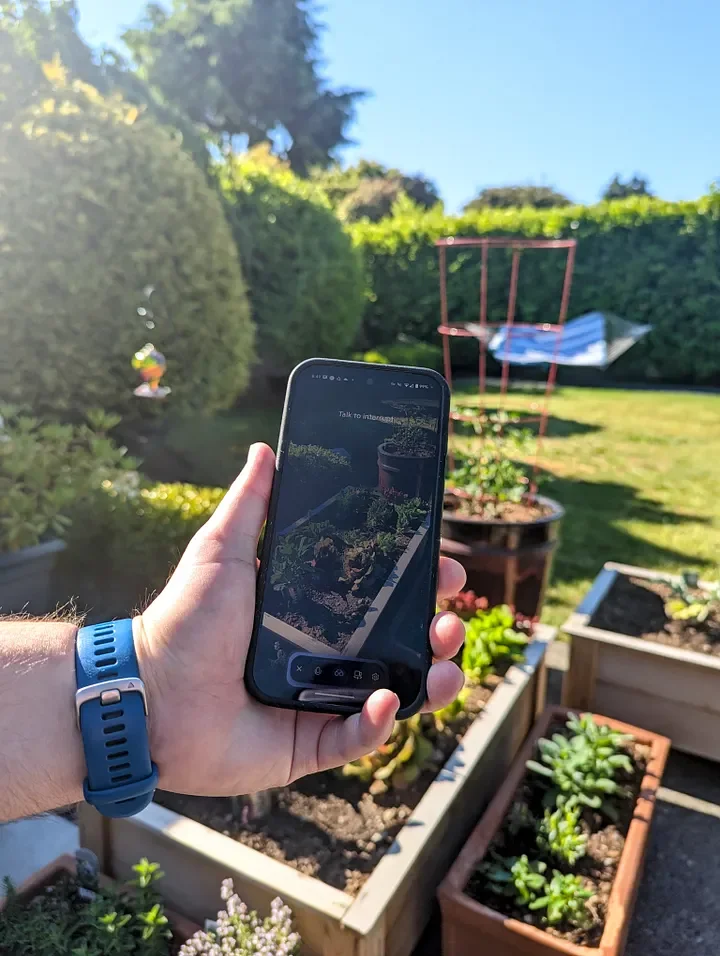
Using Copilot to learn gardening.
The first example involves learning how to garden. This spring, my wife and I committed to trying growing vegetables in our backyard for the very first time… despite both of us claiming to have brown thumbs and a long track record of unhappy plants. I knew that I needed a thought partner to help set us up for success, but I didn’t want to pester our friends and family all the time for advice. Plus it can be hard to express the vision and opportunity to an expert at a plant nursery when they don’t have the full context of your home.
This led me to using Copilot on my phone because it’s possible to talk with Copilot and give it a visual view into your world by sharing your camera. At the very beginning of our gardening journey I spent about half an hour walking around the yard peppering Copilot with a million different questions. Which plants are best suited for a sun filled south facing yard in the Pacific Northwest? Where is the ideal place in our yard for garden beds? Should the garden beds be made out of metal? Or is wood a superior construction material? What is the ideal ratio of dirt to fertilizer to soil conditioner? Which vegetables are beginner friendly? How much water should the plants get everyday? Is watering everyday a good or bad idea? This jasmine plant is looking super sad and stressed, what can we do to bring it back to health?
You probably get the idea by now. But it has been transformative to use Copilot in this seemingly simple application. The impact is readily visible in our garden, which is current thriving, and I cannot wait to literally eat the fruits of our labor.
Building community
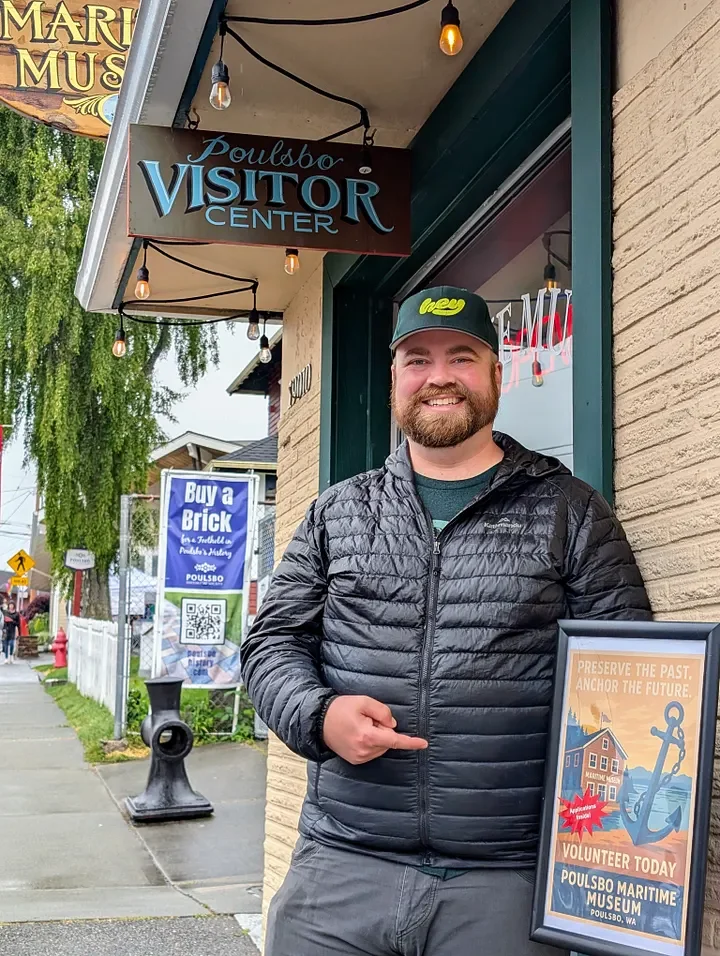
Posing with my volunteer recruitment poster.
The second example involved me helping my mom with some non-profits she volunteers for in the quaint town of Poulsbo, Washington. We had just finished going on a boat tour of Lake Washington in Seattle and stopped by a brewery for some drinks and snacks. My mom casually mentioned to me that the museums she volunteers for were having a hard time enrolling new volunteers. They needed to recruit more people to help staff the museum.
In-between sips and bites I asked my mom about her goals, perceived opportunities, and challenges with recruitment like any good UX researcher doing a foundational needs assessment interview. I learned that people were just simply unaware the museums were volunteer-run non-profits and that the main jobs-to-be-done were to advertise the volunteer opportunities and sign up recruits.
Very early on in my UX career I didn’t think that content really mattered all that much. Boy was I wrong. Fast forward a few months later I had come to the realization that content was the foundation by which all other design elements and user experiences succeeded or failed. Armed with this knowledge I knew that the museum’s marketing campaign hinged on compelling taglines that hooked the audience and biased them to take action. So I pulled out my phone and prompted our goals, challenges, and desires into ChatGPT to help generate marketing content to recruit volunteers. The first few rounds generated fairly generic content, which is to be expected, but after a couple of iterations we had landed on a phrase that was truly compelling, which was Preserve the past. Anchor the future. My mom and I knew in that moment we had a winner.
A tagline is all well and good, but it’s only the start of any good marketing campaign. You also need to tell a story visually. So I flipped over to DALLE within ChatGPT, provided a well rounded prompt full of context and goals, and used it to generate posters incorporating the tagline. After multiple rounds of iterations we landed on a poster in the style of the United States National Park Service showing a museum on the water with an anchor in the foreground and the tagline predominately highlighted.
Within the span of a beer and an appetizer I had used my phone to build the foundation of their volunteer recruitment marketing campaign. My mom was beyond enthusiastic about what we had created with these tools and couldn’t wait to share them with the museum director. Later that week, they had printed the poster, placed a copy outside on the sidewalk, and another at the register. Before they knew it they had people asking for applications and signing up for volunteer slots.
Forward thinking
Ultimately, the main takeaway I would like for people to have is that I was able to have significant impact from using generative AI as a thought partner and ideation tool to creatively explore and build solutions that solve real world problems.
It is my hope and dream to use my Medium page as a place to share my experiments, failures, successes, and lessons learned as I embark on this journey to become a more proficient maker. Hopefully this article highlights a process that everyday people can implement when they need an ideation partner to get unstuck or lift their projects up to the next level.